


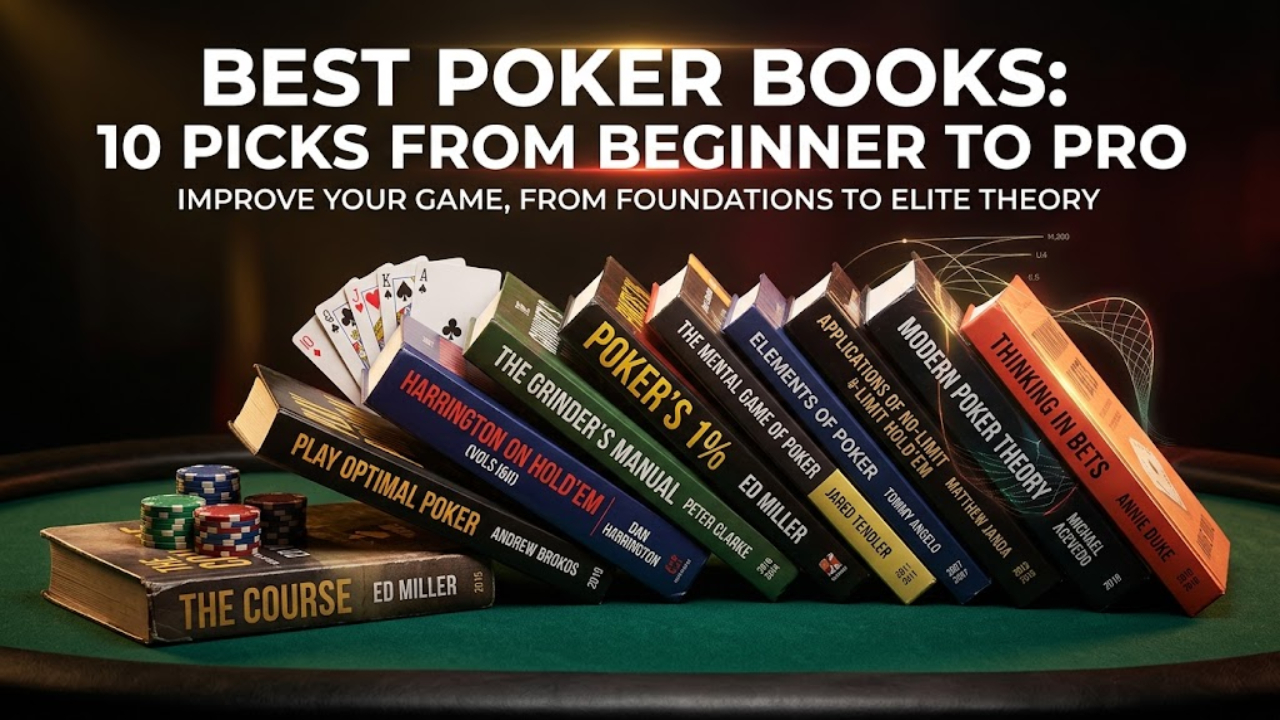
Poker books remain one of the most efficient ways to improve. A well-chosen book lets you absorb decades of professional thinking in a few hundred pages, concepts that would take thousands of hands to discover on your own. This guide covers the best poker books available in English right now, with every title verified for current availability and relevance.
Top 3 Poker Books at a Glance
| Rank | Book | Best For | Author | Year |
|---|---|---|---|---|
| 🥇 | The Course | Overall best for beginners | Ed Miller | 2015 |
| 🥈 | Modern Poker Theory | Best GTO strategy book | Michael Acevedo | 2019 |
| 🥉 | The Mental Game of Poker | Best for mindset and tilt | Jared Tendler | 2011 |
How to Choose the Right Poker Book
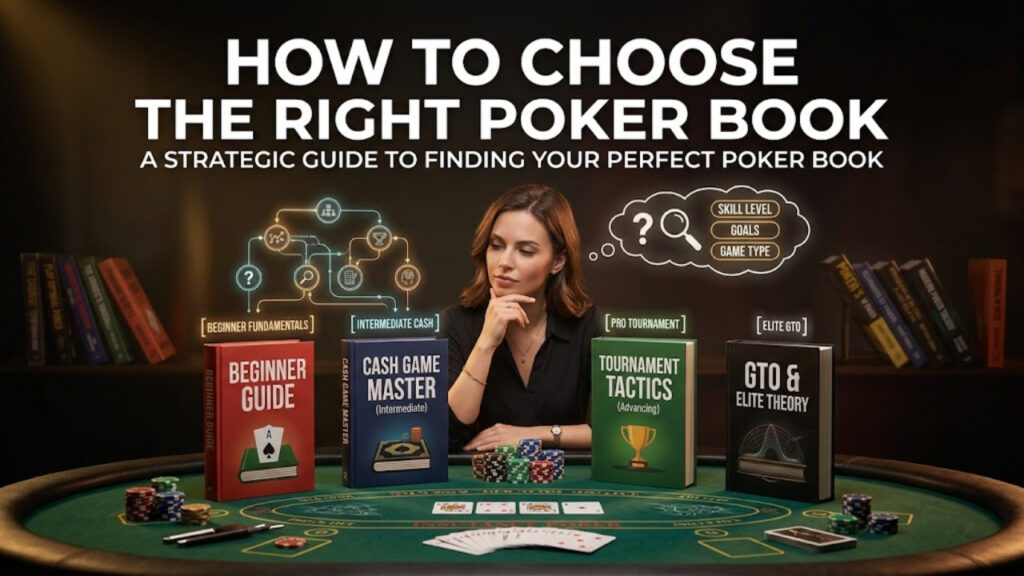
Before picking up a poker strategy book, think about two things: your current skill level and what you need to work on.
Match the Book to Your Level
A common mistake is jumping straight to advanced material. Beginners who start with a GTO textbook often struggle because they lack the foundational understanding those books assume. Start with fundamentals, then progress to intermediate and advanced material as your game develops.
Choose by What You Want to Learn
Poker books typically fall into five categories, and the right pick depends on what is costing you money right now:
- Beginner fundamentals: Hand selection, position, basic bet sizing, pot odds
- Cash game strategy: Session management, exploiting player types, stake-specific tactics
- Tournament strategy: ICM, stack depth adjustments, bubble play, final tables
- Mental game: Tilt control, confidence, motivation, handling variance
- GTO and theory: Game theory optimal play, range construction, frequency-based thinking
Beyond reading, improving at poker also means putting in hands. If you want to combine study with practice, platforms where you can play at low-stakes cash games are a good way to apply what you learn.

I’m completely new to poker. Can I just pick any book from this list?

Start with the Beginners section. The advanced and GTO books assume you already understand position, pot odds, and ranges.
\Now Trending!/
Best Poker Books for Beginners
These books teach fundamentals without overwhelming you with advanced theory. They give you a framework for thinking about poker so you can start making better decisions immediately.
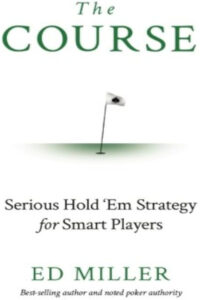
#1. The Course: Serious Hold’em Strategy for Smart Players
| Detail | Info |
|---|---|
| Author | Ed Miller |
| Published | 2015 |
| Pages | 310 |
| Format | Paperback, Kindle |
| Level | Beginner to Intermediate |
Ed Miller structured this book as a progression of skills, where each chapter builds on the previous one. You start with the most fundamental concepts, including which hands to play and from which positions, and graduate to reading opponents, adjusting to table dynamics, and understanding why certain bet sizes work.
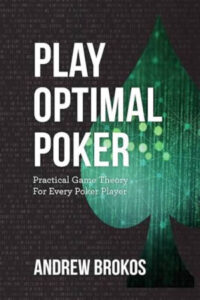
#2. Play Optimal Poker: Practical Game Theory for Every Poker Player
| Detail | Info |
|---|---|
| Author | Andrew Brokos |
| Published | 2019 |
| Pages | 243 |
| Format | Paperback, Kindle, PDF |
| Level | Beginner to Intermediate |
Despite the title, this is not an advanced GTO textbook. Brokos wrote it specifically to make game theory concepts accessible to players who find the mathematics intimidating. He starts with foundational ideas: why balance matters, what equilibrium means in practical terms, and how to give opponents difficult decisions. He builds understanding through clear examples rather than equations.
What if I only play online? Are these beginner books still relevant?
Yes. The core concepts like position and hand selection apply to every format. Once the fundamentals click, pick up The Grinder’s Manual for online-specific strategy.
\Now Trending!/
Best Poker Books for Cash Games
Cash games reward a different skill set than tournaments. Stack depths stay constant, blinds never increase, and you can leave whenever you want. These books teach you to exploit the specific opponent population at your stake level.
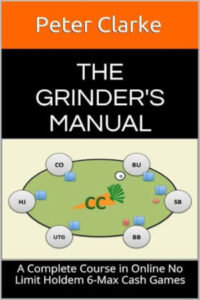
#3. The Grinder’s Manual: A Complete Course in Online No-Limit Hold’em 6-Max Cash Games
| Detail | Info |
|---|---|
| Author | Peter Clarke |
| Published | 2016 |
| Pages | 540 |
| Format | Kindle, PDF |
| Level | Beginner to Advanced |
At roughly 540 pages, The Grinder’s Manual is one of the most thorough poker books ever published. Clarke covers everything from preflop opening ranges to game-theory-informed postflop strategies, with 152 example hands analysed in detail and 80 instructive figures. The book is structured as a progressive course that starts at near-beginner concepts and climbs steeply in complexity.
Where strategy has aged: The preflop ranges and specific sizings reflect the online environment of 2016. The core reasoning and frameworks remain sound, but solvers have shifted the consensus on some opening ranges and bet sizes since publication. Use the book to understand why you should do something, and cross-reference specific frequencies with a modern solver or study app.
Some of these books are from 2014 and 2016. Is the strategy still accurate?
The reasoning holds up; only some specific ranges and sizings have shifted. Read the books for the thinking, then use a poker study app to check current numbers.
#4. Poker’s 1%: The One Big Secret That Keeps Elite Players on Top

| Detail | Info |
|---|---|
| Author | Ed Miller |
| Published | 2014 |
| Pages | 150 |
| Format | Paperback, Kindle |
| Level | Intermediate |
Miller’s central argument is that elite players think about poker in terms of frequencies: how often they bet, call, fold, and raise in specific spots, rather than making decisions hand by hand. He teaches you to evaluate your entire strategy at a positional level, identify where your frequencies are off, and adjust them toward more balanced play.
This is a gentler introduction to the thinking behind GTO than diving straight into solver outputs. It works particularly well when read after a fundamentals-focused book like The Course, as it reframes everything you have learned through a more sophisticated lens.
\Now Trending!/
Best Poker Books for Tournaments
Tournament poker demands skills that rarely come up in cash games: adjusting to changing stack depths, understanding ICM pressure near the bubble and at final tables, and shifting between tight survival and aggressive accumulation. If you are working on your tournament game, these are the essential reads.
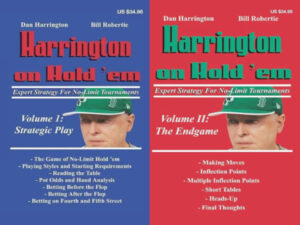
#5. Harrington on Hold’em, Volumes I & II
| Detail | Info |
|---|---|
| Author | Dan Harrington, Bill Robertie |
| Published | 2004 (Vol. I), 2005 (Vol. II) |
| Pages | 381 (Vol. I), 468 (Vol. II) |
| Format | Paperback, Kindle, Audiobook |
| Level | Beginner to Intermediate |
These two volumes are the most influential tournament poker books ever written. Volume I covers strategic play in the early and middle stages: hand selection, bet sizing, stealing, and defending blinds. Volume II focuses on the endgame: short-stack play, final table dynamics, and heads-up strategy. Harrington introduced concepts like the “M-ratio” (your stack measured in rounds of blinds and antes) that are now part of every tournament player’s vocabulary.
Where strategy has aged: Harrington wrote these books during an era when tight-aggressive play was dominant and the average tournament field was far less skilled than today. His preflop ranges are significantly tighter than what modern solvers recommend, and his approach to stealing and three-betting is conservative by current standards. Read it for the framework, then update specific ranges and sizings with modern solver-based material.
Best Poker Books for the Mental Game
You can know the correct strategy and still lose money if tilt, anxiety, or poor motivation undermine your execution. The mental game is what separates players who know the right play from players who consistently make it.
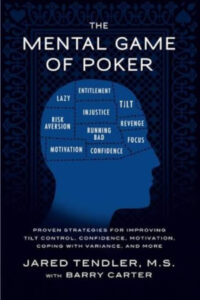
#6. The Mental Game of Poker
| Detail | Info |
|---|---|
| Author | Jared Tendler, Barry Carter |
| Published | 2011 |
| Pages | 264 |
| Format | Paperback, Kindle, Audiobook |
| Level | All levels |
Tendler is a licensed therapist who specialised in performance coaching for poker players, and this is the most systematic treatment of poker psychology ever published. Rather than offering generic advice about staying calm, he presents a framework for identifying the root causes of tilt, building a process for improving, and tracking your mental game progress over time.
What makes this book endure is that it treats mental game issues as skill deficits that can be trained, not personality flaws. Tendler also published The Mental Game of Poker 2 (2013), which goes deeper into the learning process and in-game decision quality.
\Now Trending!/
#7. Elements of Poker

| Detail | Info |
|---|---|
| Author | Tommy Angelo |
| Published | 2007 |
| Pages | 268 |
| Format | Paperback, Kindle, ebook |
| Level | All levels |
Where Tendler is clinical and systematic, Angelo is philosophical and reflective. Elements of Poker is organised into 144 short “elements,” including observations, principles, and thought experiments, that cover everything from tilt management to table selection to how your physical habits affect your play.
Angelo’s central concept is “reciprocality,” the idea that your edge comes not from what you do differently from opponents when you have a strong hand, but from what you do differently across all situations, including the boring ones and the painful ones. Many professional players list it among their top recommendations precisely because it fills a gap that no strategy book can.
#8. Thinking in Bets: Making Smarter Decisions When You Don’t Have All the Facts
| Detail | Info |
|---|---|
| Author | Annie Duke |
| Published | 2018 |
| Pages | 288 |
| Format | Hardcover, Paperback, Kindle, Audiobook |
| Level | All levels |
Duke’s book is not strictly a poker book; it is a decision-making book written by a former professional poker player. Her central argument is that good decisions should be evaluated on their process, not their outcomes, because luck plays a role in every result. The thinking habits it develops are directly applicable to poker and work well as a companion to Tendler’s more poker-focused material.
I don’t tilt that much. Do I really need a mental game book?
Tilt is only one part. Most players also have subtle leaks like avoiding tough spots or changing stakes after a bad session, and Tendler covers those too.
Start Your Poker Journey with BC Poker
BC Poker is an online poker platform where you can enjoy real poker matches against players from around the world.
In addition to a first deposit bonus and up to 50% VIP rakeback, exclusive freerolls with free entry are also available!
- First deposit bonus up to $200
- Up to 50% rakeback depending on your VIP rank
- Exclusive freeroll held every Sunday at 21:00 JST
- Available on smartphone and PC, with plenty of popular poker games
\Check the exclusive rewards with free registration!/
Best GTO Poker Books
Game theory optimal strategy, playing in a way that cannot be exploited regardless of what your opponent does, has reshaped competitive poker. These books are more demanding than other categories, but the payoff is a deeper understanding of why correct play looks the way it does.
#9. Modern Poker Theory: Building an Unbeatable Strategy Based on GTO Principles
| Detail | Info |
|---|---|
| Author | Michael Acevedo |
| Published | 2019 |
| Pages | 480 |
| Format | Paperback |
| Level | Advanced |
| Publisher | D&B Publishing |
This is the most comprehensive GTO strategy book currently in print. Acevedo built the book around solver-derived analysis of no-limit hold’em situations. It covers preflop strategy, postflop play on various board textures, bet sizing theory, and multi-street planning, all through the lens of GTO principles. The book is dense and assumes familiarity with basic poker concepts, and you will likely need to work through sections multiple times.
#10. Applications of No-Limit Hold’em
| Detail | Info |
|---|---|
| Author | Matthew Janda |
| Published | 2013 |
| Pages | 378 |
| Format | Paperback, Kindle |
| Level | Intermediate to Advanced |
| Publisher | Two Plus Two Publishing |
Janda’s book was one of the first to apply rigorous game theory analysis to no-limit hold’em in a way that was both theoretically sound and practically useful. It covers range construction, balancing value bets and bluffs, optimal bet sizing, and equity distribution across different board textures.
Where strategy has aged: Applications predates the widespread availability of commercial solvers, and some of its specific conclusions have been refined by more recent computational analysis. However, the reasoning framework it teaches, thinking about poker in terms of ranges and frequencies rather than individual hands, remains foundational. Many players find that reading Janda before Acevedo makes Modern Poker Theory considerably more digestible.
Poker Book Comparison Overview
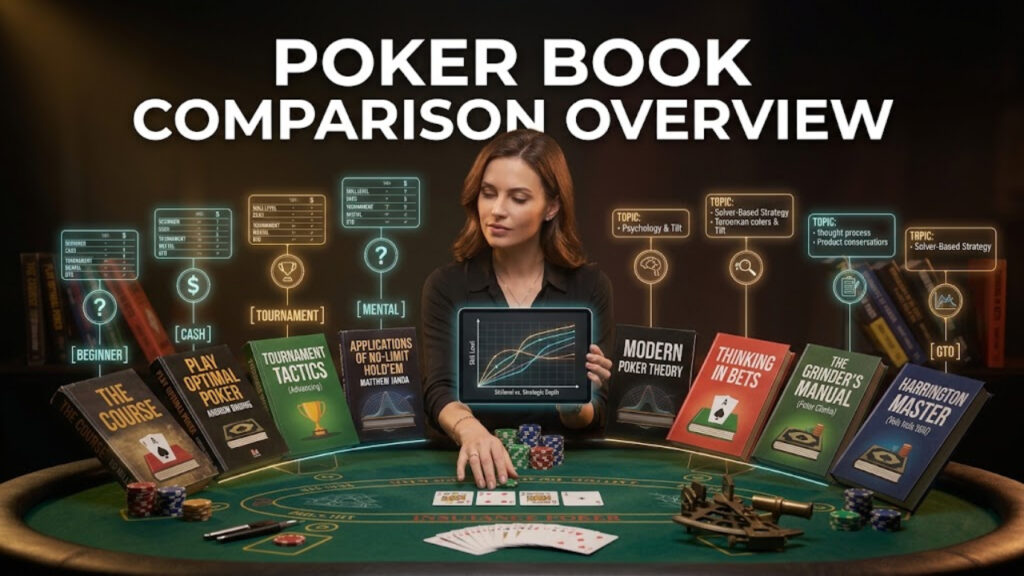
| # | Book Title | Author | Year | Level | Best For | Pages |
|---|---|---|---|---|---|---|
| 1 | The Course | Ed Miller | 2015 | Beginner | Overall fundamentals | 310 |
| 2 | Play Optimal Poker | Andrew Brokos | 2019 | Beginner–Intermediate | Accessible game theory | 243 |
| 3 | The Grinder’s Manual | Peter Clarke | 2016 | All levels | Online cash games | 540 |
| 4 | Poker’s 1% | Ed Miller | 2014 | Intermediate | Frequency-based thinking | 150 |
| 5 | Harrington on Hold’em I & II | Dan Harrington | 2004–05 | Beginner–Intermediate | Tournament foundations | 849 |
| 6 | The Mental Game of Poker | Jared Tendler | 2011 | All levels | Tilt and mental performance | 264 |
| 7 | Elements of Poker | Tommy Angelo | 2007 | All levels | Poker philosophy and leaks | 268 |
| 8 | Thinking in Bets | Annie Duke | 2018 | All levels | Decision-making process | 288 |
| 9 | Modern Poker Theory | Michael Acevedo | 2019 | Advanced | Comprehensive GTO | 480 |
| 10 | Applications of NLHE | Matthew Janda | 2013 | Intermediate–Advanced | GTO foundations | 378 |
PROVEN RELIABILITY.
Tigergaming has maintained a secure and profitable environment for recreational players since its establishment in 1999.

Exclusive Player Rewards
- 100% welcome match up to $1,000
- Apply Tigergaming promo code NEWTG
- Lucrative weekly cash rakeback payouts
High-Value Game Features
- Enter Tigergaming bonus code for maximum value
- Windfall Jackpots reaching $75,000 prize pools
- Fast-reflecting cryptocurrency banking support
\Poker Welcome Bonus/
Poker Books vs Courses and Apps
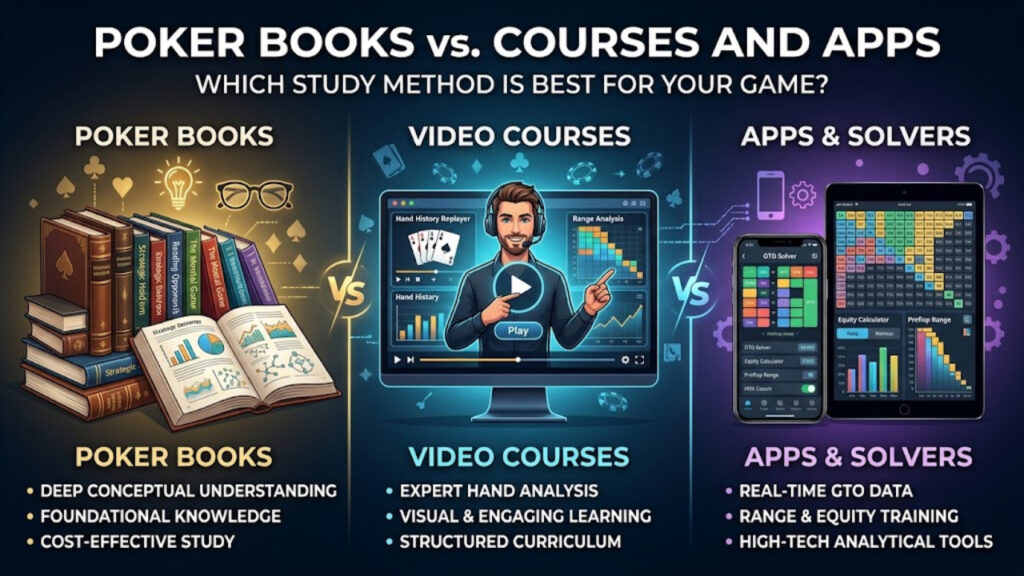
Books are not the only way to study poker, and they are not always the best way. Here is when each format works best.
| Details | Books | Video Courses | Study Apps and Solvers |
|---|---|---|---|
| Best for | Deep conceptual understanding | Seeing strategy applied in real time | Drilling specific spots and verifying theory |
| How it teaches | Develops ideas sequentially, chapter by chapter | Coach plays hands and explains decisions live | Shows exact frequencies, lets you practise repeatedly |
| Strengths | Cost-effective, easy to reference, works offline | Clarifies concepts that feel abstract on the page | Trains decisions until they become automatic |
| Weaknesses | No interactive feedback or real-time demonstration | More expensive, harder to reference quickly | Difficult to use without a conceptual foundation first |
| When to use | Start here to build your foundation | After reading, to see concepts demonstrated | After studying, to train the spots you have learned |
The ideal approach combines all three: books for understanding, courses for demonstration, and apps for practice. Start with books to build your foundation, then use apps to train the spots you have studied.
Suggested Reading Order
If you are working through multiple books, this sequence builds concepts in a logical progression.
Stage 1: Fundamentals: Start with The Course by Ed Miller. It establishes the core skills you need for every format and introduces sound strategic thinking without overwhelming you with theory.
Stage 2: Choose your format: If you play primarily cash games, move to The Grinder’s Manual by Peter Clarke. If you focus on tournaments, read Harrington on Hold’em, Volumes I & II.
Stage 3: Mental game: Before going deeper into strategy, read The Mental Game of Poker by Jared Tendler. The earlier you build good mental habits, the more effectively you will absorb everything else.
Stage 4: Theory: Read Play Optimal Poker by Andrew Brokos for an accessible introduction to game theory, then Poker’s 1% by Ed Miller for frequency-based thinking. When those concepts are solid, move to Applications of No-Limit Hold’em by Matthew Janda and then Modern Poker Theory by Michael Acevedo.
Stage 5: Perspective: Read Elements of Poker by Tommy Angelo and Thinking in Bets by Annie Duke. These work best after you have enough experience to recognise the patterns they describe.
BATTLE-TESTED. BEGINNER FRIENDLY.
BetOnline provides a secure gaming environment backed by over three decades of industry experience and global player traffic. Our comprehensive Betonline poker review highlights how users benefit from soft competition on the Chico Poker Network and rapid payout systems.

Exclusive Bonus Offers
- 100% deposit match up to $1,000.
- Enter promo code NEWBE to activate.
- 21 free satellite tournament tickets.
Professional Gaming Features
- Staggered rakeback with 0x wagering.
- Fast-reflect cryptocurrency payment options.
- Dedicated Betonline poker app support.
\+100 Free Spins!/
FAQ
Are older poker books still worth reading?
Many are, but with caveats. Books that teach fundamental concepts like positional play, pot odds, hand reading, and psychological discipline remain relevant because those principles have not changed. What has shifted is the specific application: preflop ranges, bet sizing conventions, and default strategies have evolved significantly since the pre-solver era. Read older books for the frameworks and reasoning, then validate specific ranges and sizings against modern tools.
What is the single best poker book for a complete beginner?
The Course by Ed Miller is the strongest choice for most beginners. It teaches the game in a logical sequence of skills, uses clear language, and focuses on practical play at stakes most people actually encounter. If you prefer a more theory-oriented introduction, Play Optimal Poker by Andrew Brokos is an excellent alternative.
Do I need to understand GTO to win at low-stakes poker?
Not fully, but a basic understanding helps. At lower stakes, most of your profit comes from exploiting opponents’ mistakes rather than playing a balanced strategy. However, understanding GTO principles helps you recognise where opponents are deviating and how to punish those deviations more effectively. Start with Poker’s 1% for a gentle introduction before committing to heavier GTO material.
Should I read poker books or use a solver instead?
They serve different purposes. Books teach you how to think about poker: the concepts, frameworks, and reasoning behind correct play. Solvers show you numerically precise answers for specific situations. Without the conceptual foundation that books provide, solver outputs are difficult to interpret and nearly impossible to generalise from. Read first, then use solvers to refine what you have learned.
How many poker books should I read before playing seriously?
One or two well-chosen books, studied carefully and applied at the table, will do more for your game than skimming ten. Start with a fundamentals book and a mental game book, play enough hands to encounter the situations they describe, then return to study more advanced material when you can articulate specific questions about your game.
Are poker books or video courses better for learning?
Neither is universally better; they complement each other. Books build deeper conceptual understanding and are easier to revisit for reference. Video courses are better for seeing strategy demonstrated in real time. If you only have budget for one, books offer better value per pound or dollar. If you can afford both, read the book first, then watch courses on the same material to reinforce your understanding.



Comments