



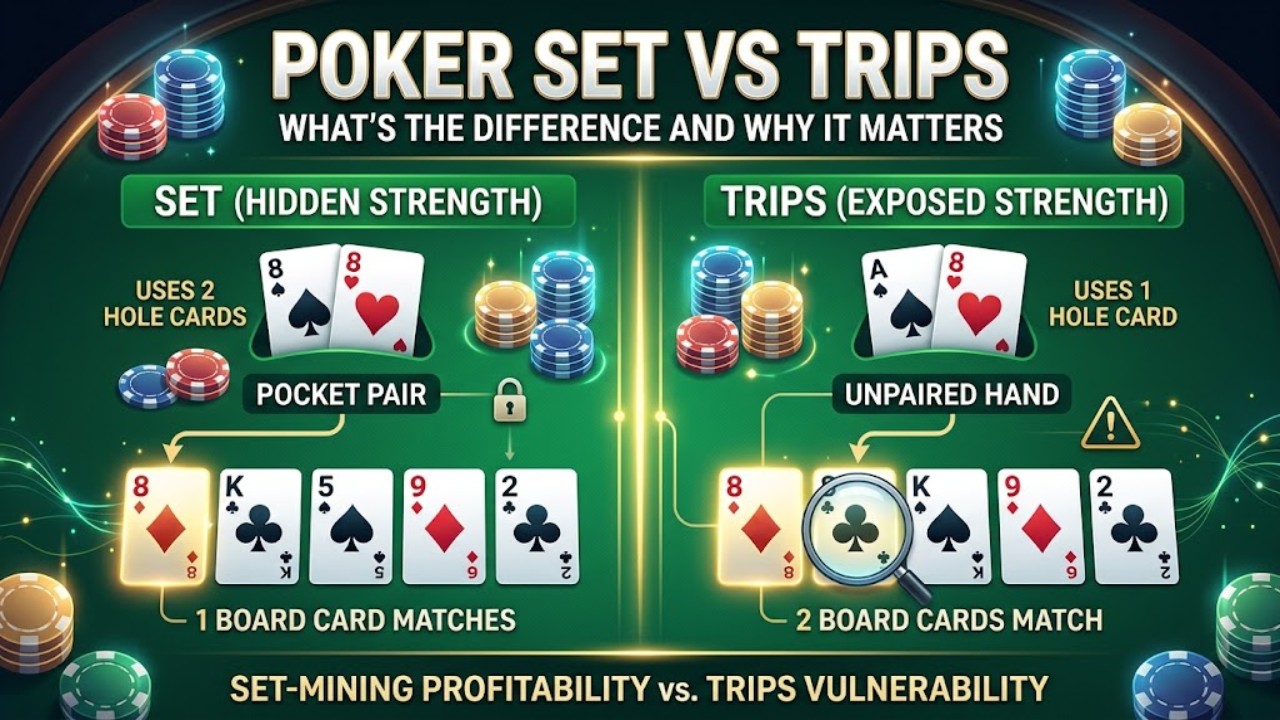
A set and trips both give you three of a kind in poker, but they are made in different ways, and that difference has a huge impact on how profitable each hand is. Understanding set vs trips is essential for any Texas Hold’em player. A set in poker comes from holding a pocket pair and matching it with one community card, while trips come from holding one card that pairs with two matching cards on the board. Sets are more disguised, more profitable, and generally much easier to play.
This poker set vs trips guide breaks down the distinction in detail, covering exact definitions, the probability math behind flopping a set in poker, and the strategic differences that separate winning players from losing ones.
What Is a Set in Poker?
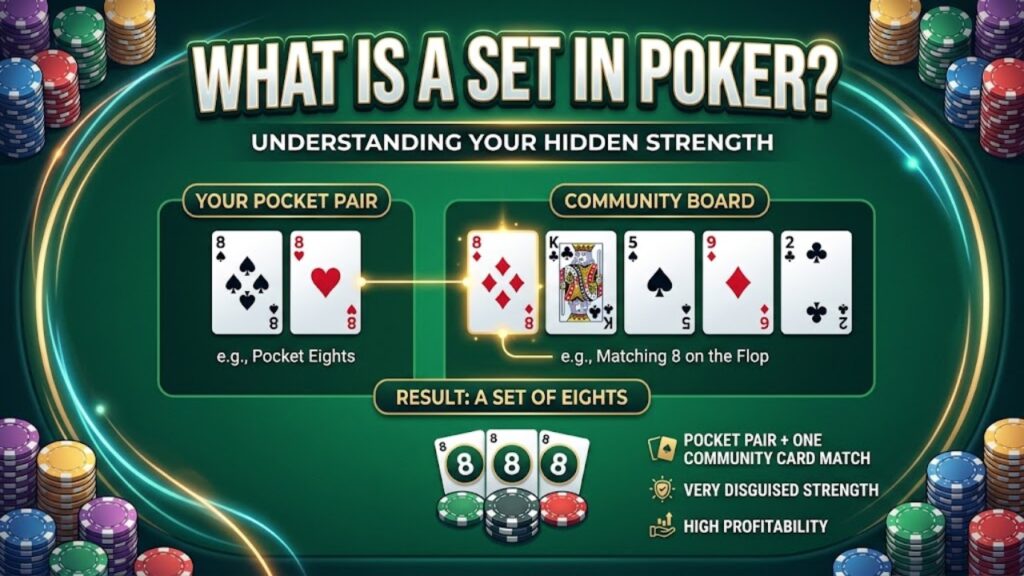
A set in poker is a specific type of three of a kind where you hold a pocket pair in your hand, and a third card of the same rank appears on the board. Of the two ways to make three of a kind, a set in poker is the stronger and more profitable version.
Example:
- Your hand: 8♠ 8♥
- Board: 8♦ K♣ 5♠ 9♦ 2♣
- Result: A set of eights
The defining feature of a set in poker is that two of the three matching cards are hidden in your hand. Your opponents can see only one eight on the board; they have no obvious reason to suspect you hold three of a kind. This is what makes a set in poker one of the most profitable hands you can hold: your strength is almost invisible.
In standard poker terminology, you would say you “flopped a set” if the third card appeared on the flop, or simply that you “have a set of eights.” If you hold pocket aces and an ace appears on the board, that is called a “set of aces”: the strongest possible set in poker.

Can I make a set without holding a pocket pair?

No. A set in poker requires a pocket pair in your hand. Without one, matching a board pair gives you trips, not a set.
\Now Trending!/
What Are Trips in Poker?
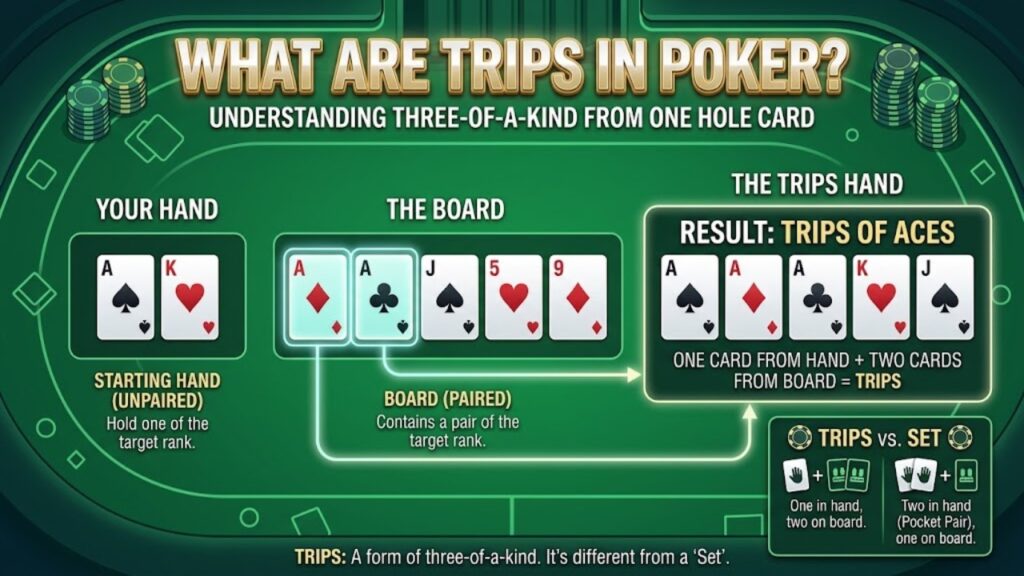
Trips (short for “triplets”) is three of a kind where you hold one card in your hand that matches a pair already showing on the board. In the set vs trips comparison, trips is the weaker and more exposed version.
Example:
- Your hand: A♠ 8♥
- Board: 8♦ 8♣ K♠ 9♦ 2♣
- Result: Trips (eights)
Here, the board already shows a pair of eights. You hold the third eight in your hand. Unlike a set in poker, two of the three matching cards are visible to everyone at the table. This is the core of the set vs trips difference: visibility.
\Now Trending!/
Set vs Trips: Key Differences
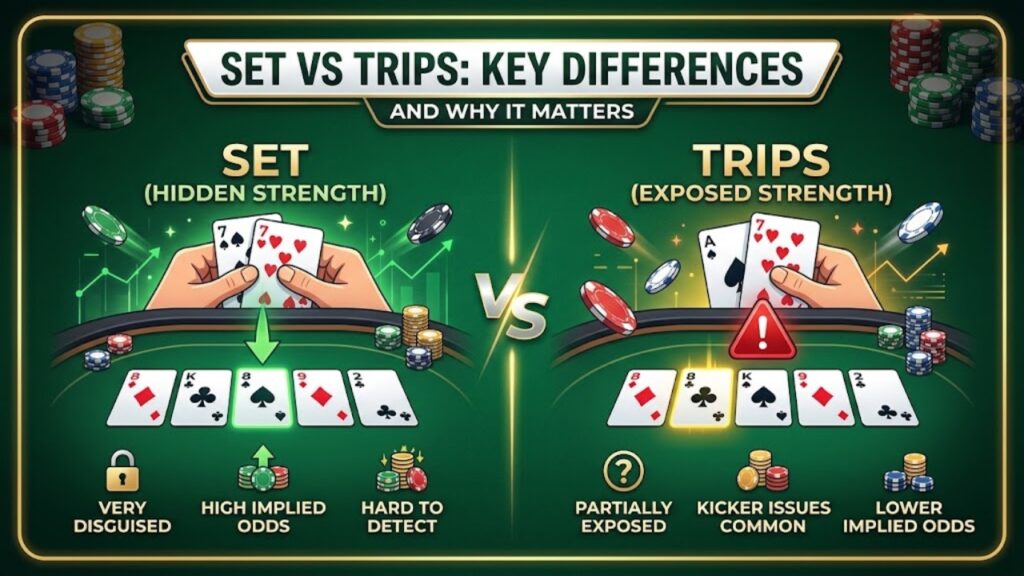
Although a set and trips both produce three of a kind and rank equally in the hand rankings, they play very differently in practice. The poker set vs trips distinction matters for three main reasons: disguise, kicker safety, and implied odds. Here is a side-by-side comparison:
| Factor | Set | Trips |
|---|---|---|
| Your hole cards | Pocket pair (e.g., 7♠ 7♥) | Unpaired (e.g., A♠ 7♥) |
| Board texture | One card of your rank on the board | A pair of your rank on the board |
| Hidden strength | Very well disguised: two cards hidden | Partially exposed: paired board is visible |
| Opponent awareness | Low: hard to detect | Higher: paired board alerts opponents |
| Kicker issues | Rarely a problem | Common: other players may also have trips with a better kicker |
| Full house potential | Strong: any board pair gives you a full house | Weaker: you need to pair your other hole card |
| Overall profitability | Very high | Moderate |
Kicker vulnerability is the second major difference in the set vs trips breakdown. If the board shows 8♦ 8♣ K♠ and you hold A♠ 8♥, any other player also holding an eight has trips, and whoever has the better kicker wins. With a set in poker, this problem almost never arises because only one card of your rank is on the board.
Are trips ever worth playing aggressively?
Yes, especially with a strong kicker like an ace. But dial back the aggression compared to a set since the paired board gives your opponents a warning.
\Now Trending!/
Odds of Flopping a Set in Poker
To flop a set, you need to start with a pocket pair and then have exactly one of the two remaining cards of that rank appear among the three flop cards. Knowing the odds of flopping a set is critical for making profitable pre-flop decisions.
The Math
You hold two cards of rank X. That leaves 2 remaining cards of rank X in a 50-card deck (52 minus your 2 hole cards). The flop deals 3 cards.
P(flopping at least one match) = 1 − P(no match in 3 cards)
P(no match) = C(48, 3) ÷ C(50, 3)
- C(48, 3) = (48 × 47 × 46) ÷ 6 = 17,296
- C(50, 3) = (50 × 49 × 48) ÷ 6 = 19,600
P(no match) = 17,296 ÷ 19,600 = 0.8824
P(flopping a set or better) = 1 − 0.8824 = 0.1176 ≈ 11.8%
That works out to roughly 7.5-to-1 against flopping a set with any pocket pair. In other words, you will flop a set in poker about once every 8.5 attempts with a pocket pair.
Probability Table: Set by Street
| Street | Cards Dealt | Probability | Approximate Odds |
|---|---|---|---|
| By the flop | 3 community cards | 11.8% | ~7.5 to 1 |
| By the turn | 4 community cards | 15.5% | ~5.4 to 1 |
| By the river | 5 community cards | 19.2% | ~4.2 to 1 |
Do the odds change depending on which pocket pair I hold?
No. Pocket aces and pocket twos both flop a set exactly 11.8% of the time. The math is identical for every pair.
What About Set Over Set?
Set over set (sometimes called SOS) occurs when two players both hold pocket pairs and both flop a set. It is one of the most expensive situations in poker because both players feel confident they hold a near-unbeatable hand.
In a full-ring cash game, the probability of running into set over set when you flop a set is roughly 1 to 2%, depending on the number of opponents. It is rare enough that you should not play scared of it, but common enough over a lifetime of hands that you will encounter it, and it will usually cost a full stack. The poker set vs trips dynamic is irrelevant here; both hands are sets, and the higher pocket pair wins.
Implied Odds: Why a Set in Poker Is So Profitable
The 7.5-to-1 odds against flopping a set might seem steep, but a set in poker remains one of the most profitable holdings thanks to implied odds: the money you expect to win on later streets when you hit.
Here is why implied odds make pocket pairs worth playing:
You only need to flop a set roughly 1 in 8 times to break even, but when you do hit, you often win your opponent’s entire stack. In a typical cash game with 100 big blind stacks, you might invest 5–10 big blinds pre-flop to see a flop with a pocket pair. When you miss (roughly 88% of the time), you fold cheaply. When you hit a set in poker, you can often win 50–200 big blinds from opponents who hold top pair, overpairs, or two pair and cannot believe you have three of a kind.
This is another area where the set vs trips gap is clear. Trips have weaker implied odds because the paired board makes opponents cautious, so you are less likely to win a large pot even when you have the best hand. A set in poker, by contrast, hides your strength and lets opponents make expensive mistakes.
Should I fold small pocket pairs if someone raises big pre-flop?
Often yes. If the raise is too large relative to remaining stacks, implied odds aren’t there. Apply the Rule of 15: multiply the call size by 15 and fold if stacks are shorter.
\Now Trending!/
How to Play a Set in Poker Effectively

Flopping a set puts you in an enviable position, but you still need to extract maximum value. The way you play a set in poker depends on board texture, opponent type, and position.
Bet for value on most board textures
A common beginner mistake is slowplaying a set on a wet, draw-heavy board (for example, 9♠ 8♦ 7♥ when you hold 9♥ 9♣). On these boards, straights and flushes can arrive quickly; you want to build the pot while your hand is almost certainly best. Bet or raise and let drawing hands pay to chase.
Slowplaying is fine on dry boards
If the flop is K♠ 7♦ 2♣ and you hold 7♠ 7♥, there are very few draws that can beat you. Checking or just calling a bet can keep weaker hands in the pot and disguise your strength for a bigger payoff on later streets.
Consider your opponent’s likely hand range
If you suspect your opponent has a strong hand (for example, they three-bet pre-flop and the board has an ace when you hold a set of aces), you can afford to play aggressively because they are likely to call or even raise. Against a passive opponent who only calls, smaller bets that keep them in the hand are often more profitable than large bets that scare them away.
Position matters
In position (acting after your opponent), you have the luxury of controlling the pot size and deciding when to put money in. Out of position, you need to decide between donk-betting (leading into the pre-flop aggressor), check-raising, or check-calling; each line works best on different board textures and against different opponent types.
Playing trips vs playing a set
The set vs trips difference also affects post-flop strategy. With trips, you should generally be less aggressive because opponents can see the paired board and will fold more often. With a set in poker, you can build larger pots because your hand is hidden.
I flopped a set but the board has three to a flush. Should I slowplay?
No. On draw-heavy boards, bet or raise immediately. You want to charge flush draws now, not give free cards that can beat your set.
Start Your Poker Journey with BC Poker
BC Poker is an online poker platform where you can enjoy real poker matches against players from around the world.
In addition to a first deposit bonus and up to 50% VIP rakeback, exclusive freerolls with free entry are also available!
- First deposit bonus up to $200
- Up to 50% rakeback depending on your VIP rank
- Exclusive freeroll held every Sunday at 21:00 JST
- Available on smartphone and PC, with plenty of popular poker games

\Check the exclusive rewards with free registration!/
Common Mistakes: Set vs Trips Play
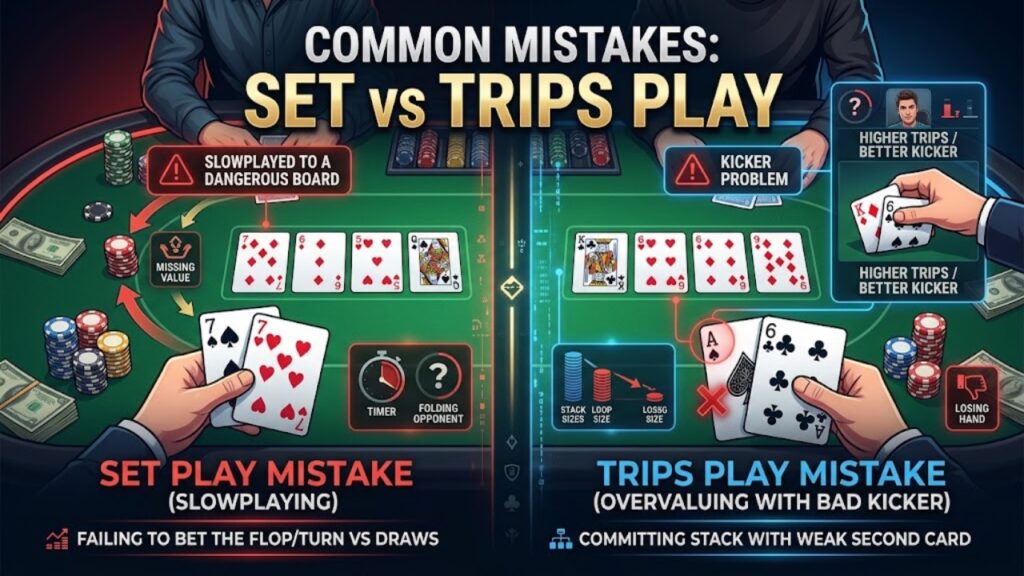
Even experienced players misplay three of a kind. Knowing the poker set vs trips distinction is only half the battle; you also need to avoid these common pitfalls:
Trips with a weak kicker (for example, holding 6♠ 3♥ on a 6♦ 6♣ K♠ board) can easily be beaten by another player who also holds a six but with a better kicker. Do not automatically commit your entire stack with trips unless you have a strong kicker or reads on your opponent.
Flopping a set of fives on a board of J♠ T♥ 5♦ feels great, but this board is loaded with straight and flush draws. If you check the flop and turn trying to trap, you give free cards that can easily beat you. Bet and protect your hand.
If a very tight, passive player suddenly raises and re-raises you on a dry board when you have a set, consider that they might have a higher set. It is rare, but ignoring the warning signs is how you lose 200 big blinds in one hand.
Pocket pairs like 2♠ 2♥ are playable when stacks are deep and you can see a cheap flop, but calling a large pre-flop raise out of position with short stacks is a losing play. The implied odds simply are not there, and even when you flop a set in poker, a low set on a high board is vulnerable.
When you have trips and the board pairs, you now have a full house, but so might your opponent if they had a set. Pay attention to how the board develops and adjust your aggression accordingly.
BATTLE-TESTED. BEGINNER FRIENDLY.
BetOnline provides a secure gaming environment backed by over three decades of industry experience and global player traffic. Our comprehensive Betonline poker review highlights how users benefit from soft competition on the Chico Poker Network and rapid payout systems.

Exclusive Bonus Offers
- 100% deposit match up to $1,000.
- Enter promo code NEWBE to activate.
- 21 free satellite tournament tickets.
Professional Gaming Features
- Staggered rakeback with 0x wagering.
- Fast-reflect cryptocurrency payment options.
- Dedicated Betonline poker app support.
\+100 Free Spins!/
Test Your Knowledge: Poker Set vs Trips Scenarios
Try these scenarios to see if you understand the poker set vs trips difference and can pick the right play:
Scenario 1: You hold Q♠ Q♥. The flop comes Q♦ 7♣ 3♠. Do you have a set or trips?
Answer: You have a set of queens. You hold a pocket pair, and one queen appeared on the board. Two of your three queens are hidden. This is a monster hand on a very dry board; consider slowplaying to let opponents catch up. This is the ideal set in poker situation.
Scenario 2: You hold K♠ 9♥. The flop comes 9♦ 9♣ 4♠. Do you have a set or trips?
Answer: You have trips (nines). The board is paired, and you hold the third nine. Be cautious; any other player holding a nine has trips too, and your king kicker matters. In set vs trips terms, this is the weaker version of three of a kind.
Scenario 3: You hold 5♠ 5♥ in a cash game. A player raises to 3 big blinds pre-flop. You are on the button with 120 big blinds. Should you call?
Answer: Yes. The implied odds are strong. You need to invest 3 big blinds and have roughly 120 big blinds behind, well above the Rule of 15 threshold (3 × 15 = 45). If you flop a set in poker, you have a great chance of stacking an opponent with an overpair or top pair.

FAQ
Is a set stronger than trips?
In terms of hand rankings, a set and trips are the same; they are both three of a kind. However, a set in poker is strategically much stronger because it is better disguised, less vulnerable to kicker problems, and typically wins bigger pots. The poker set vs trips difference is about playability, not rank.
How often will I flop a set in poker with a pocket pair?
Approximately 11.8% of the time, or about once every 8.5 flops. By the river, the probability of making a set in poker rises to roughly 19.2%.
Should I always call pre-flop with a pocket pair hoping to flop a set?
Not always. You need sufficient implied odds, generally at least 15 times the pre-flop call in remaining stack depth. In short-stacked situations (under 25–30 big blinds), small pocket pairs lose their value because even when you hit a set in poker, you cannot win enough to offset the times you miss.
Can I have a set in Omaha poker?
Yes, but the terminology works the same way. If you hold a pair among your four hole cards and one matching card appears on the board, you have a set. The poker set vs trips distinction applies in Omaha just as it does in Hold’em. Since Omaha deals four hole cards, pocket pairs and sets arise more frequently, and three of a kind is generally a weaker relative hand.
What should I do when I suspect set over set?
Set-over-set situations are difficult because both hands are very strong. The main warning signs are extreme aggression from a tight player on a dry board. If a normally passive opponent raises and re-raises you on a board like K♠ 7♦ 2♣, consider the possibility that they hold a higher pocket pair than yours. In practice, though, folding a set is rarely correct; most of the time you are up against two pair, a bluff, or a draw.
Where can I practice playing sets and trips?
Online poker rooms let you play thousands of hands per hour, giving you far more opportunities to practice poker set vs trips scenarios than live play. Check our Online Poker Ranking for recommended sites where you can work on recognizing and playing a set in poker profitably.
For more on calculating poker probabilities and understanding how often specific hands occur, see our full guide to Poker Probability.



Comments