



“How do I get better at Texas Holdem poker?”
“Is there actually a way to get better at it?”
It is one of the most common questions asked by new and aspiring players. While luck plays a role in short-term results, consistent success comes from developing strong fundamentals, understanding strategy, and making better decisions than your opponents.
In this guide, you’ll learn how to get better at Texas Holdem poker through proven techniques, practical tips, and winning mindsets that can help you build confidence and improve your performance at the tables.


What is Texas Hold’em Poker?
If you’re new to the game, here’s the quick version: Texas Hold’em is a game where you try to make the best hand using your two private “hole cards” and five “community cards” shared by everyone.
Because you don’t know your opponent’s cards, the game is all about using your actions (betting, checking, etc.) to represent the strength of your hand.
If you want to learn more about the basics of Texas Hold’em read the blog below!
Are There “Tricks” to Getting Better at Poker?
After explaining Texas Hold’em I’m sure there will be players wondering “how do I get better at poker?”
While luck plays a role in the short term, poker is recognized as a professional career for a reason. There are clear techniques that separate pros from amateurs. Let’s dive into the specifics!
9 Techniques On How to Get Better at Texas Hold’em Poker
We’ve identified nine major techniques that will transform your play.
Master these, and you’ll stop gambling and start playing strategically.
1. Master the Rules
Don’t jump straight into a high-stakes game. Start with free apps to get a feel for the rhythm.
Focus on the Dealer Button and the order of action—it’s the foundation of everything.
2. Define Your Playstyle
After learning the rules, choose your play style.
Most pros recommend a Tight-Aggressive (TAG) style for beginners, though Loose-Aggressive (LAG) can be fun.
- Tight-Aggressive (TAG) → Play few hands, but play them strongly.
- Loose-Aggressive (LAG) → Play more hands and use bluffs to keep opponents guessing.
Pick a style you admire, try it out, and adjust as you learn.
3. Memorize Proper Hand Ranges
Once you have become more comfortable with the flow of the game, the next step is to learn the proper hand ranges for yourself.
While hand ranges can vary slightly from person to person, here is a general perspective.
- Tight-Aggressive (TAG) → Top 10% of hands from UTG
- Loose-Aggressive (LAG) → Top 15% of hands from UTG
If you are aiming to become a tight player, make it your goal to participate in the game only about once every ten hands when you are in the UTG (Under the Gun) position.
Conversely, if you have been playing a style where you enter almost every hand during the pre-flop stage, you need to consult a hand range chart and start making adjustments.
4. Understand Pot Odds
The final technique for moving beyond the beginner level is a proper understanding of pot odds.
Pot odds represent the ratio between the total amount of chips currently in the pot and the amount of chips you are required to call.
For example, if there are 100 chips in the pot and your opponent bets 200, and your winning probability is 30%, you should not call.
This is because, based on odds calculations, you would need a win rate of over 60% to make that call profitable.
*We will explain the specifics of this calculation in detail later.
Once you can make these kinds of decisions—knowing exactly when to fold and when to push—you can finally say you’ve graduated from the beginner stage.
For more details on odds, please refer to the following article.
5. Stop Reckless Calling/Raising
Directly related to our previous discussion on pot odds is the importance of avoiding reckless calls and raises. Making these moves while ignoring pot odds puts you at significant risk of depleting your chip stack.
A common mistake among beginners is chasing draws—unnecessarily calling bets just to see the turn or river.
You must be careful, as the mathematical probability of completing a draw is lower than many realize: a flush draw has approximately a 36% chance of hitting, while an open-ended straight draw has only about a 24% chance.
6. Avoid “Face-Up” Play
As you advance, you must ensure your actions aren’t too easy to read. A common mistake is “playing face-up”—such as always calling with a pair and always folding without one.
This type of play is highly exploitable; it signals to your opponents exactly when to bluff. To prevent this, you should learn to balance your range and occasionally fight for pots with Ace-high. The goal is to make your actions “unreadable” to the rest of the table.
7. Read the “Tells”
Another essential technique is identifying “tells.” Contrary to popular belief, tells aren’t just for live games; online poker has them too (often in the form of timing or bet sizing). Learning to decipher these signals is a powerful way to put your opponent on a specific hand.
8. Mark Your Opponents
Whether you are playing live or online, tagging your opponents is a crucial habit to develop.
“Marking” or “Tagging” refers to taking notes on your opponents’ playstyles. This allows you to identify exploitable players and target them aggressively. Pay close attention to beginners who make reckless calls or raises, and make sure to “mark” them for future hands.
Most online poker apps include a color-coding feature for this exact purpose. By accurately labeling your opponents, you can make better decisions and significantly increase your win rate.
9. Master the Different Actions
Once you have mastered the techniques we’ve discussed so far, it’s time to expand your overall strategy.
Keep in mind that the tips covered here are designed to help you transition from a beginner to an intermediate level. The road to becoming an advanced, high-stakes player is long and requires constant study.
In the next section, we will dive into more complex, intermediate-level strategies to help you continue your progress.
Essential Action Knowledge for Mastering Texas Hold’em
For players moving past the beginner stage, it is crucial to understand the underlying nature and strategic impact of each action.
Below is a brief breakdown of how these actions function in a game.
Bet
A “bet” occurs from the flop onwards when no other player has put chips into the pot during that specific round.
This is an aggressive action that forces your opponents to make a decision: call, fold, or raise. Advanced players understand the high strategic value of betting and will use it frequently to maintain control of the hand.
Call
A “call” is generally considered a passive or “weak” action.
This is because a call is always a reaction to someone else’s bet or raise; you are letting the opponent dictate the flow of the game. However, be careful—some players use calls as part of a “slow play” strategy, where they act weak despite having a very strong hand to trap their opponents.
Raise
A “raise” is an aggressive action where you increase the size of an opponent’s existing bet.
If you increase the amount of the very first raise in a betting round, it is technically a re-raise, commonly known as a “3-bet.” In the later stages of a tournament, a 3-bet will often result in an all-in.
Check
A “check” is essentially a “pass.”
By checking, you indicate to your opponent that you want the game to continue without adding more chips. This can lead to situations where your position suddenly becomes very weak.
- Pre-flop: You 3-bet (4x) against an opponent’s initial raise.
- Flop: You check.
- Opponent: Bets.
Even though you showed strength with a 3-bet pre-flop, checking the flop suggests you may have missed the board with hands like AK or AQ. This gives the opponent an opening to bet and potentially force you to fold.
Essential Knowledge of “Game Flow” for Improving at Texas Hold’em
To improve at Texas Hold’em, having a solid grasp of the “game flow” is absolutely essential.
In this section, we will explain the progression of a hand, commonly referred to as the “Flop, Turn, and River.“
Phase 1: Pre-flop
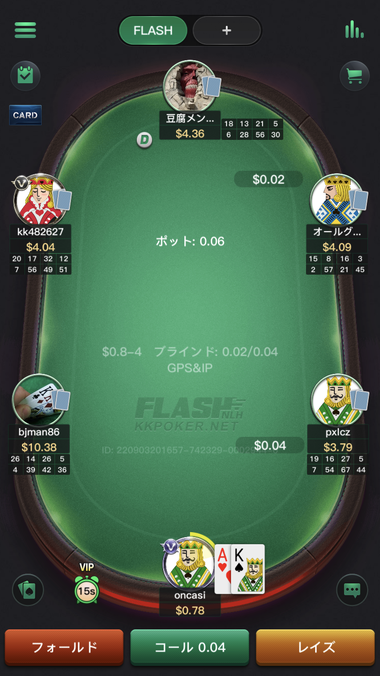
The dealer deals two cards (hole cards) to every player.
The action starts with the player sitting immediately clockwise from the Big Blind (in this specific hand, that was me).
The Big Blind (BB) is the player required to put in a predetermined bet before the cards are dealt. In this game, the BB was $0.04. You can see the player to my upper right has posted this $0.04.
Meanwhile, the player to the immediate counter-clockwise side of the BB is the Small Blind (SB). The SB posts half of the BB amount (in this case, the player to the upper right posted $0.02).
Phase 2: The Flop (3 Community Cards)
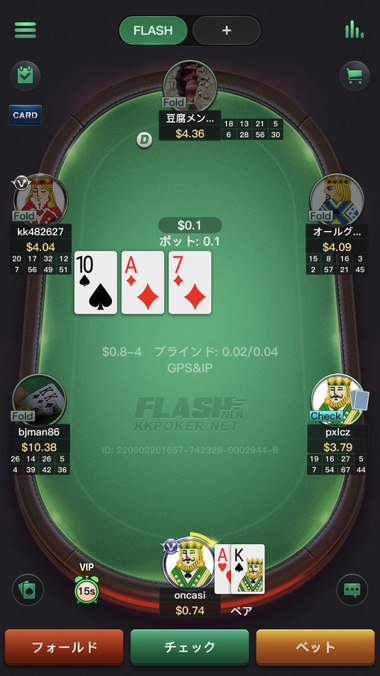
Three cards are dealt face-up in the center of the table.
These are known as the “Community Cards.” In this example, an Ace appeared on the board.
Since I held an Ace in my hand, I now have a pair of Aces (AA).
Phase 3: The Turn (4th Community Card)
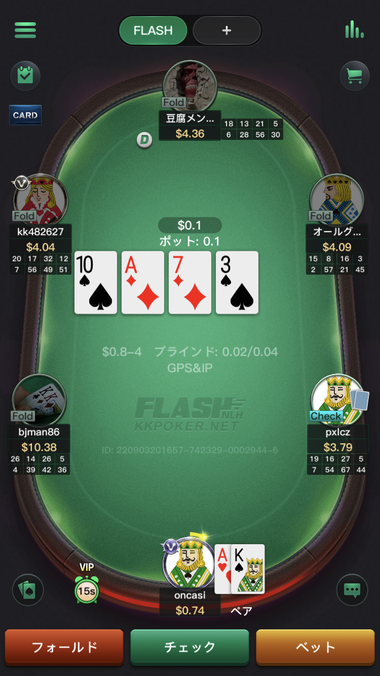
In Texas Hold’em, the “Turn” refers to the third betting round.
A fourth community card is dealt face-up on the board.
Phase 4: The River (5th Community Card)
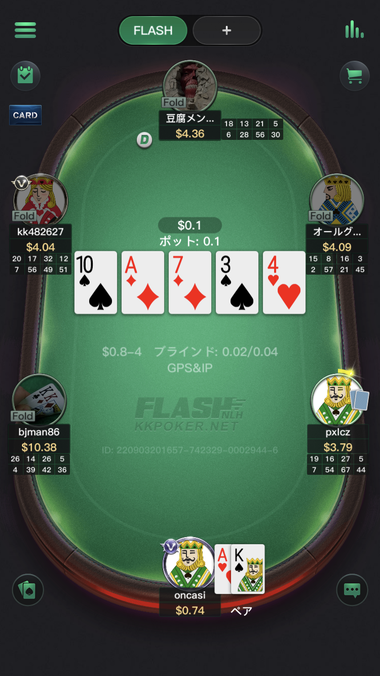
The final betting round is the “River,” where the fifth and final community card is dealt.
If an unlikely reversal occurs on this final card causing a strong hand to lose, it is known as a “Bad Beat.”
The Conclusion: Showdown (Revealing Hands)
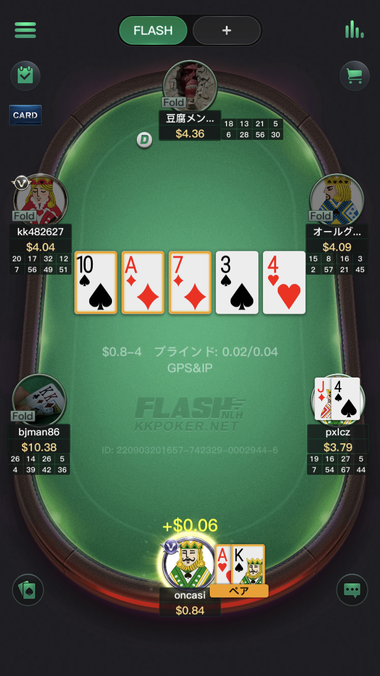
After the River action is complete, we move to the Showdown.
All players who have not folded (given up) reveal their hole cards to determine the winner.
In this instance, I had a pair of Aces (AA) and my opponent had a pair of Fours (44), so I was lucky enough to take down the pot.
(Note: The screenshots used here are from the KKPoker app.)
\Limited Bonuses!/
Mastering Probabilities: The Key to Improving at Texas Hold’em
Next, let’s dive into one of the most significant aspects of Texas Hold’em strategy: probability. Understanding the math behind the game is what separates consistent winners from casual players.
In this section, we will cover the following essential topics.
- Outs and Odds Calculation
- Equity Calculation
- Fold Equity
- Implied Odds
Let’s get started!
Outs and Odds Calculation
While you can use hand range charts to determine your win rate pre-flop, once you reach the flop, you must begin calculating your “Outs.”
To decide whether a call is mathematically profitable, you need to compare your chances of hitting an out with the pot odds offered to you.
Calculating Outs
Suppose you are currently behind but have a flush draw. If we assume that completing your flush guarantees a win, your win probability is approximately 36%.
This calculation is performed by determining the probability of hitting your required cards (“outs”) on the turn and the river.
For a flush draw, you have 9 outs remaining—calculated by subtracting the 4 cards you already hold (2 in your hand and 2 on the board) from the 13 total cards of that suit.
Since you have two opportunities to hit these outs, the probability is calculated as 9 × 2% × 2 times = 36%. (The 2% represents the approximate probability of drawing one specific card from the remaining cards in the deck.)
Calculating Odds
Now that you have calculated your win rate using outs, the next step is calculating the odds.
Odds are calculated as the ratio between the combined total of the chips already in the pot plus your opponent’s bet, and the amount you must wager to continue in the hand.
A specific situation is as follows.
- Pot: 100
- Opponent’s bet: 200
- You have a flush draw; should you call?
The answer is that calling is not justified by the odds, as the required win rate is 40% (3:2).
For example, if the opponent bets 50, the required win rate becomes 25% (3:1), meaning calling can be considered a sound decision.
Equity Calculation
Equity represents your “rightful share” of the pot based on your current probability of winning.
If there is 100 in the pot and you have a flush draw (assuming it’s a guaranteed win if it hits).
- Flop: Opponent 64% / You 36% (Your equity: 36)
- Turn: Opponent 82% / You 18% (Your equity: 18)
- River: Opponent 100% / You 0% (or vice versa)
At the river, unless the pot is chopped (split), the player with the winning hand takes 100% of the equity.
Fold Equity
Fold Equity is the additional value you gain by forcing your opponent to fold, thereby seizing their share of the pot.
Using the same example.
- Flop: Opponent 64% / You 36% (Your equity: 36)
- Turn: Opponent 82% / You 18% (Your equity: 18)
- River: Opponent 100% / You 0% (or vice versa)
If you make a bet on the flop that causes your opponent to fold, you instantly capture their 64% equity. Even if you only have a 36% chance of winning the hand at showdown, the “equity” you gain from their fold makes aggressive play very effective.
Implied Odds
Implied odds calculation is a method that takes into account the amount you expect to win by the end of the hand, even if you are currently behind.
Since it involves many variables and requires predicting future odds, you can consider it quite complex.
Here is a calculation based on a set of assumptions:
Assumptions:
Opponent’s hand: AA, stack of 100, will always go all-in on the river.
Your hand: 89, stack of 100.
The flop comes 10-7-4, and the opponent bets 50 into a 100 pot.
At this point, if you call the 50 bet, your equity (win rate) is slightly too low to justify the call based on immediate pot odds (which are 3:1).
However, if you know they will go all-in on the river and you hit your straight, how does the calculation change?
Even though the current call is 50, the additional 50 you expect to win in the future makes the effective pot odds 4:1, meaning a call becomes profitable with a 20% win rate.
Summary: Strategic Betting Techniques to Master Texas Hold’em
In this final section, we will summarize the essential betting techniques that will help you level up your Texas Hold’em game.
We will cover the following key strategies:
- Bluff Bet
- Value Bet
- Continuation Bet (C-bet)
- Block Bet
Bluff Bet
A bluff bet takes advantage of hidden information to deceive your opponent and prevent them from realizing their equity.
Bluffs are generally categorized into “Pure Bluffs” (zero chance of winning at showdown) and “Semi-bluffs” (a bet made with a drawing hand that could still improve). Pure bluffing is a high-level skill that requires a deep understanding of your opponent’s tendencies.
Value Bet
A value bet is an aggressive action taken to build the pot when you believe you have the best hand.
The goal is to get called by a worse hand. This includes targeting “Thin Value”—making small bets that an opponent might call with even a weak pair—as well as going for “Big Value” in massive cooler situations, such as a Full House vs. an Ace-high Flush.
Continuation Bet (C-bet)
A Continuation Bet (often called a C-bet) is a bet made on the flop by the player who was the aggressor pre-flop, regardless of whether they actually hit the board.
For example, if you held AK and were the pre-flop raiser against 89, you would C-bet the flop to maintain your narrative of strength. This is a standard play often used when you hold premium hands that missed the flop but still likely have the best hand or high equity.
Block Bet
A Block Bet (or Blocking Bet) is a small “lead-out” bet made to prevent your opponent from making a much larger bet themselves.
Imagine a scenario where you have AK-high and your opponent has AQ-high.
On the river, instead of checking—which might invite the opponent to make a large bluff—you lead with a small bet. This allows you to dictate the price of the showdown.
Since the opponent also has a marginal hand, they are unlikely to raise, allowing you to see their cards as cheaply as possible.
For more details on the Block Bet, please refer to the following article.
Tips for Improving at Texas Hold’em
In this section, we will introduce several essential tips for leveling up your Texas Hold’em game.
- Adapt your strategy based on position
- Utilize bluffs effectively
- Observe your opponents closely
If there are tips to get better, I definitely want to know them…!
Of course, it’s not like ‘Know these tips and you’ll always win!!’ The key is to play consistently while keeping these principles in mind…!
Adapt Your Strategy Based on Position
The first step toward becoming a better Texas Hold’em player is understanding how to play differently depending on your position.
For instance, in the Live Blinds (SB/BB) or Early Position (EP), the standard rule is to play only very strong hands.
In Middle Position (MP), it is important to stay relatively tight and avoid playing “loose” as much as possible.
Furthermore, in Late Position (LP), you should focus on taking advantage of the information you have on others and using bluffs to move the game in your favor.
I see… so the way you think changes depending on where you’re sitting..
This is just a general overview, but position is a vital element in the psychological battle of poker…!
Utilize Bluffs Effectively
To play Texas Hold’em at an advantage, learning how to use bluffs is crucial.
I’m really bad at bluffing… do I have to do it?
It’s dangerous for beginners to over-bluff, but if you never do it, you’ll end up at a disadvantage…
A player who never bluffs is extremely easy for others to read. Because of this, you might become “bait” for Shark players (highly skilled players).
If you determine that your hand is likely weaker than your opponents’, try incorporating some bluffs.
If a “Pure Bluff” feels too difficult, “Semi-bluffs” (bluffing with a drawing hand) are much easier for beginners to incorporate into their game.
Observe Your Opponents Closely
To reach the advanced level, you must develop the habit of observing your opponents.
While you can’t see physical “tells” or gestures in online poker, there is still plenty of information to be gained from how people play. For example, some players might act very quickly when they have a weak hand, or conversely, take a long time to decide whether to call or raise when they have a monster hand.
While this won’t allow you to read an opponent’s hand 100% of the time, the stance of “gathering every single piece of information possible” is vital.
Good Habits for Improving at Texas Hold’em
Here are three effective habits to help you master Texas Hold’em.
Study with Books
To improve, it’s important to absorb knowledge and theory from books, not just through actual play. Improving at poker requires you to think deeply and strengthen your theoretical foundation.
While you can gain experience from various situations during live play, books allow you to systematically learn how to handle specific patterns and offensive strategies.
If you feel like your progress has stalled, returning to theory through a book might provide the breakthrough you need.
Check out the article below for recommended poker books.
Prioritize Mental Control
Mental control is indispensable if you want to win consistently.
No matter how much you know about poker theory, if your mind is unsettled, you won’t be able to make the best decisions.
For example, a losing streak can make you feel timid or desperate, causing you to lose the patience needed for tight play. In live games, your frustration or anxiety will often show up in your facial expressions and body language.
Think of mental control as an essential skill for your poker development.
Saying ‘don’t let your heart break’ sounds like a platitude, but in the world of gambling, if your spirit wavers, opponents will immediately seize that opening…!
Get as Much Game Experience as Possible
Alongside studying theory, it is important to play as many games as possible. Theories only truly become yours once you have put them into practice.
To get daily exposure to poker, we recommend using online poker services.
With online poker, you can play whenever you have free time, regardless of where you are.
There are so many online poker services… which one do you recommend?
Well, I’d recommend KKPoker! It has plenty of beginners and a great selection of freerolls.
Check out our recommendations for online poker below.
If you’re unsure which service to choose, try KKPoker. It features easy-to-use controls and a wide variety of freeroll tournaments.
Frequently Asked Questions About Improving at Texas Hold’em
Texas Hold’em is becoming increasingly popular thanks to various poker movements and media coverage, leading many people to look for ways to improve.
We receive many questions through this site, so we have answered some of the most common ones below.
The topics covered are as follows.
- Should I learn GTO?
- What is “Exploitative Play”?
- Should I use hand range charts exactly as they are?
Let’s look at each one.
Should I Learn GTO?
If you spend any time in the poker world, you will likely hear the term “GTO” (Game Theory Optimal).
While many players strive to play a perfect GTO style, it is generally recommended that you wait until you are an advanced player before diving deep into GTO study.
Of course, it is essential to learn the basics—such as understanding which hands are strong enough to call or raise when an opponent is betting with a wide range of random hands.
However, rather than obsessing over whether a specific decision is “perfectly GTO,” you should focus on gaining practical experience and understanding the fundamentals first.
What is Exploitative Play?
“Exploiting” (or Exploitative Play) is often used as the opposite of GTO. It refers to any style of play that specifically targets and traps an opponent based on their weaknesses.
Exploitative play is vital because if we assume every player is trying to follow GTO, reversing those rules allows you to find a bigger “edge” (profit).
For example, if you notice an opponent only calls or raises with pocket pairs of 10-10 or higher, the most profitable strategy is to constantly bet against them to force a fold whenever they don’t have those specific hands. Reading an opponent’s habits and hand ranges to counter their specific style is what we call “Exploiting.”
You can find a more detailed explanation in the article below.
Should I Use Hand Range Charts Exactly As They Are?
The final question concerns hand range charts.
While many beginners rely on these charts while playing, it becomes dangerous to follow them strictly once you reach the intermediate level or higher.
This is because your opponents also know these ranges and will use that knowledge to exploit your predictability.
Instead, you should use ranges in the following way.
- Adjust your range based on the number of players.
- Adjust your range based on your opponents.
Let’s look at these briefly.
Adjust Your Range Based on the Number of Players
You need to increase your “tightness” as the number of players at the table increases.
For example, if you are at a 10-handed table and you are UTG (Under the Gun), you should only raise with the top few percent of hands.
Conversely, in a Heads-up (1v1) situation, hands like K-10 or Q-10 offsuit are strong enough to call an all-in.
Adjust Your Range Based on Your Opponents
You should also adjust your range flexibly depending on who you are playing against.
If an opponent is playing very “loose” (playing too many hands), you will profit more by playing “tight.”
Conversely, if an opponent is extremely “tight,” you can play “loose” and camouflage your range. This makes it impossible for the opponent to put you on a specific hand, leading them to “over-call” or “over-fold.”
This ability to adjust to your opponents is a requirement for advanced-level play.
To Improve at Texas Hold’em Learn the Terminology
In this article, we introduced numerous techniques to help you improve your Texas Hold’em game.
The latter half might have been a bit challenging as we included some technical jargon.
However, mastering these terms is essential for beginners looking to advance to an intermediate level or beyond.
Therefore, let’s continue to study as much as possible while gaining practical experience at the tables.
Thanks for reading!



Comments