


Not every poker bonus is worth claiming. A headline number like “$2,000 deposit match” means nothing if the wagering terms are punishing, the release rate is glacial, or the bonus expires before you’ve cleared half of it.
This page exists for one reason: to cut through the noise. While our best online poker sites guide covers overall quality, this ranking zooms in specifically on bonus value, the deposit matches, no-deposit offers, freeroll access, and rakeback programs that actually put money back in your bankroll. We’ve compared release mechanics, rakeback percentages, and clearing difficulty across every major room so you can sign up knowing exactly what you’re getting.
Below, you’ll find our ranked picks, detailed reviews of each site’s bonus structure, and a breakdown of how we test them.
Best Poker Bonus Offers at a Glance
| Rank | Site | Bonus Offer | Bonus Type & Highlight | Standout Feature | Rating |
|---|---|---|---|---|---|
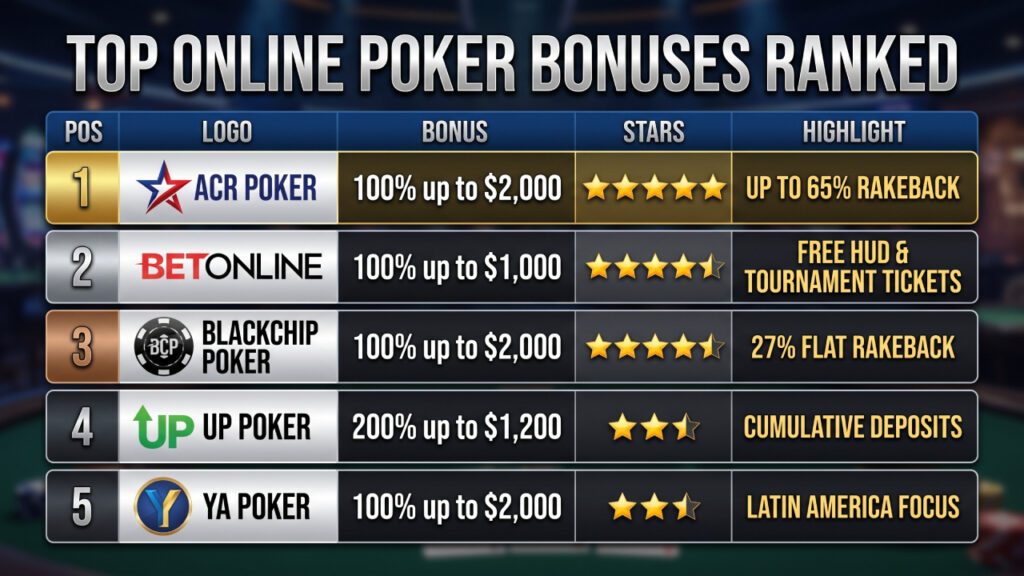
| 1 | ACR Poker | 100% up to $2,000 | Deposit match; $1 released per $5 rake | Up to 65% rakeback via Elite Benefits; $15M Venom series | 9.0/10 |
| 2 | BetOnline | 100% up to $1,000 | Deposit match + free tournament tickets | Bad Beat Jackpot; free HUD software included | 8.7/10 |
| 3 | BlackChip Poker | 100% up to $2,000 | Deposit match; same WPN network as ACR | 27% flat rakeback option from day one | 8.5/10 |
| 4 | UP Poker | 200% up to $1,200 | Highest match percentage; cumulative deposits | Up to 40% VIP rakeback; soft player pool | 8.3/10 |
| 5 | Ya Poker | 100% up to $2,000 | Deposit match on WPN; Latin American focus | Excellent mobile app; 27% flat or Elite Benefits | 8.1/10 |
| 6 | BC Poker | 10% up to $200 + $5 no-deposit | Instant deposit bonus + no-deposit free play | Crypto-native; up to 50% VIP rakeback | 7.8/10 |
\Now Trending!/

I only have $50 to deposit. Which poker bonus actually gives me the most value on a small bankroll?

With $50, UP Poker is the best choice, offering a 200% match for $150 in total funds. For zero risk, BC Poker offers $10 free with no deposit required.
Individual Site Reviews

ACR Poker — 9.0/10
Why We Picked It: Americas Cardroom is the flagship of the Winning Poker Network and offers one of the most complete bonus packages in online poker. The $2,000 deposit match is among the highest available, and the Elite Benefits loyalty program can push your effective rakeback to 65% — a number few competitors match.
- Largest deposit match ceiling among US-friendly poker rooms at $2,000
- Elite Benefits program delivers up to 65% rakeback for high-volume players
- Massive tournament schedule including the $15 million GTD Venom series
- Daily $50 GTD freerolls in multiple formats give bonus holders additional value
- 60-day clearing window is shorter than some competitors, requiring consistent volume
- The player pool attracts experienced grinders, particularly above NL50
- Crypto deposits are recommended — fiat options are more limited
Best For: Tournament grinders who want the biggest welcome bonus paired with massive tournament guarantees, including the $15M Venom series.
\Now Trending!/
I keep hearing about “rakeback.” Is that different from the bonus, and can I get both at the same time?
Yes, they stack. The welcome bonus is one-time, while rakeback continues every time you play. ACR Poker offers up to 65% rakeback, while BlackChip Poker provides a flat 27% rakeback from day one.
BetOnline — 8.7/10
Why We Picked It: BetOnline is the flagship of the Chico Poker Network and stands out for its tournament infrastructure and unique bonus extras. The free HUD software — a tool that competitors charge separately for — and one of the highest bad beat jackpots in the industry add ongoing value beyond the welcome offer itself.
- Free HUD software included automatically — saves the cost of third-party tracking tools
- Bad Beat Jackpot payouts can be significant and distribute to all players at the same stake level
- Sportsbook and casino crossover traffic creates a softer player pool than pure poker networks
- Tournament ticket giveaway provides immediate value alongside the deposit match
- $1,000 maximum bonus trails ACR and BlackChip by half
- 30-day clearing window is tight for recreational players
- Shares the Chico Network player pool with TigerGaming, so traffic overlaps
Best For: Tournament players who value integrated software tools and jackpot-style bonus mechanics alongside their deposit match.
BATTLE-TESTED. BEGINNER FRIENDLY.
BetOnline provides a secure gaming environment backed by over three decades of industry experience and global player traffic. Our comprehensive Betonline poker review highlights how users benefit from soft competition on the Chico Poker Network and rapid payout systems.

Exclusive Bonus Offers
- 100% deposit match up to $1,000.
- Enter promo code NEWBE to activate.
- 21 free satellite tournament tickets.
Professional Gaming Features
- Staggered rakeback with 0x wagering.
- Fast-reflect cryptocurrency payment options.
- Dedicated Betonline poker app support.
\+100 Free Spins!/
BlackChip Poker — 8.5/10
Why We Picked It: BlackChip Poker mirrors ACR’s $2,000 welcome bonus on the same Winning Poker Network but differentiates itself through a more straightforward approach to rakeback. The 27% flat rakeback option — available from day one with no tier climbing required — makes it one of the most transparent ongoing value propositions in online poker.
- 27% flat rakeback is one of the highest guaranteed rates in the industry — no tier grinding needed
- Same $2,000 bonus and WPN tournament schedule as ACR, including the $15M Venom series
- No bonus code required — the welcome offer activates automatically on first deposit
- Excellent freeroll selection with tournaments running nearly around the clock
- Shares the WPN player pool with ACR and Ya Poker — if you already play ACR, the games are identical
- 60-day clearing window can be challenging for low-volume players
- Less brand recognition than ACR, though the product is functionally the same
Best For: Cash game grinders who prioritize a guaranteed, transparent rakeback rate over tiered loyalty programs.
\Now Trending!/
UP Poker — 8.3/10
Why We Picked It: UP Poker offers the highest match percentage on this list — a 200% deposit bonus up to $1,200 — and the cumulative deposit structure means you can claim the full amount across multiple deposits within 90 days rather than committing a large sum upfront.
- 200% match is the highest percentage on this list — double what most competitors offer
- Cumulative deposit structure across 90 days accommodates smaller bankrolls
- No bonus code required — the offer activates automatically
- VIP rakeback scales up to 40%, compounding on top of the welcome bonus
- $1,200 cap is lower in absolute terms than ACR or BlackChip’s $2,000
- Smaller player pool compared to the major networks
- The points-per-cent release mechanic requires significant volume to fully clear
Best For: Players who prefer a higher match percentage with the flexibility to build their bonus through multiple smaller deposits.
\Now Trending!/
Ya Poker — 8.1/10
Why We Picked It: Ya Poker runs on the Winning Poker Network alongside ACR and BlackChip, giving players access to the same deep tournament schedule and player pool. Its standout advantage is a polished mobile experience and a Latin American-focused community, which often translates to softer tables during peak hours.
- Access to the full WPN tournament schedule, including the $15 million GTD Venom series
- Superior mobile app for both iOS and Android — ideal for players who primarily play on their phone
- Daily freebuys serve as an effective no-deposit starting point for new players
- Latin American traffic creates softer peak-hour games compared to ACR
- Same WPN player pool as ACR and BlackChip — no unique games or traffic
- No standalone no-deposit poker bonus currently available
- Smaller brand presence may mean less direct customer support resources
Best For: Mobile-first players and those who’ve already claimed bonuses at ACR or BlackChip but want a fresh welcome offer on the same network.
BC Poker — 7.8/10
Why We Picked It: BC Poker — backed by the team behind BC.Game Casino — is the strongest crypto-native option on this list. While the deposit bonus is modest, the $5 no-deposit bonus (plus an additional $5 for downloading the mobile app) lets players test the room completely risk-free. The real long-term value lies in up to 50% VIP rakeback and an ultra-soft player pool fed by casino crossover traffic.
- $10 combined no-deposit bonus with no cashout cap — genuine risk-free testing
- Provably fair RNG on the Ethereum blockchain adds a layer of transparency
- Casino-fed player pool is among the softest available — ideal for bankroll building
- Near-instant crypto withdrawals in BTC, USDT, USDC, and ETH
- 10% deposit match is the lowest on this list by a wide margin
- Crypto-only platform — no fiat deposit options available
- Small player pool means limited game selection outside peak hours
- Relatively new room (launched in 2025) with less track record than established sites
Best For: Crypto players who want to start risk-free with a no-deposit bonus and benefit from soft games fed by casino traffic.
\Now Trending!/
Can I really sign up at ACR, BlackChip, and Ya Poker and claim a separate $2,000 bonus at each one?
Yes, you can. All three use the Winning Poker Network, sharing the same players and tournaments. Each site offers its own welcome bonus, allowing up to $6,000 in total bonus value across three $2,000 deposit matches.
How We Test and Rank the Best Online Poker Bonuses

Our rankings aren’t based on headline numbers alone. A $2,000 bonus with brutal clearing requirements can be worth less than a $1,000 bonus that releases smoothly. Here’s what we evaluate, in order of importance for this ranking:
We calculate the real-dollar value of each bonus based on release rate, match percentage, and any instant components (free play, tournament tickets, no-deposit offers). A bonus you can actually clear beats a bigger one you can’t.
We examine how bonus funds release — per-dollar-of-rake increments, point-based systems, or time-locked batches. We penalize opaque clearing mechanics and reward transparency. Poker bonuses differ significantly from casino bonuses here: most poker bonuses release through rake contribution rather than traditional wagering multipliers, which generally makes them more player-friendly.
The welcome bonus is a one-time event. What matters long-term is the ongoing rakeback structure. We evaluate how each site’s loyalty program compounds on top of the initial bonus and whether the effective return rate holds up at different volume levels.
Some bonuses come bundled with freeroll entries, satellite tickets, or promotional tournament access. We assess the realistic value of these extras — a daily freeroll with a $500 prize pool is worth more than a monthly one with $100.
A generous bonus with a 30-day expiry is effectively worthless for most recreational players. We factor in the time pressure each bonus imposes relative to a typical player’s volume.
Every site on our list operates under at least one recognized gambling license. We verify regulatory status and confirm that bonus terms comply with applicable standards in the jurisdictions where each site operates. Players should review the UK Gambling Commission or their local gaming authority for region-specific guidance.
These secondary factors still matter because a bonus is only as good as the platform behind it. We test mobile apps, measure peak-hour player counts, and evaluate customer support responsiveness.
Start Your Poker Journey with BC Poker
BC Poker is an online poker platform where you can enjoy real poker matches against players from around the world.
In addition to a first deposit bonus and up to 50% VIP rakeback, exclusive freerolls with free entry are also available!
- First deposit bonus up to $200
- Up to 50% rakeback depending on your VIP rank
- Exclusive freeroll held every Sunday at 21:00 JST
- Available on smartphone and PC, with plenty of popular poker games
\Check the exclusive rewards with free registration!/
FAQs
What types of poker bonuses are available?
Online poker rooms typically offer four main bonus types. Deposit match bonuses are the most common: the site matches a percentage of your first deposit (usually 100%, though UP Poker offers 200% —up to a cap. No-deposit bonuses credit a small amount of free play just for registering — BC Poker’s $10 combined offer is a standout example. Freeroll tickets grant entry to real-money tournaments with no buy-in. Reload bonuses work like deposit matches but target existing players making subsequent deposits. Most rooms combine several of these into a welcome package.
How do poker bonus wagering requirements work?
Poker bonuses release differently from casino bonuses. Instead of a flat multiplier (like a 30x wagering requirement), most poker bonuses unlock incrementally as you generate rake. For example, ACR Poker and BlackChip Poker release $1 of bonus for every $5 in rake paid. This means your clearing speed depends on how much you play and at what stakes — higher stakes generate more rake per hour. Always check the specific release mechanics: BetOnline releases $5 per $50 in rake, while UP Poker uses a points-per-cent system that requires more granular calculation.
Can I claim bonuses at multiple poker sites on the same network?
Yes — and this is a key strategy for maximizing value. ACR Poker, BlackChip Poker, Ya Poker, and True Poker all run on the Winning Poker Network and share the same player pool and tournament schedule (including the $15M GTD Venom series). Claiming a fresh welcome bonus at each one gives you up to four separate $2,000 match opportunities while playing against the same opponents. Similarly, BetOnline and TigerGaming share the Chico Network, so you can stack bonuses across both.
What’s the difference between a poker bonus and rakeback?
A poker bonus is a one-time promotional offer, typically tied to your first deposit. Rakeback is an ongoing return: a percentage of the rake you pay at the tables comes back to your account, either through a formal loyalty program or a flat deal. The best strategy combines both — claim a welcome bonus while also enrolling in the site’s rakeback program so you earn returns from day one. BlackChip Poker’s 27% flat rakeback is one of the most transparent examples: you get back 27 cents of every dollar you pay in rake, indefinitely.
How long do I have to clear a poker bonus?
Clearing windows vary significantly. ACR Poker, BlackChip Poker, and Ya Poker all give you 60 day. BetOnline and TigerGaming offer only 30 days. UP Poker is the most generous at 90 days, and its cumulative deposit structure means you can keep adding funds and bonus throughout that window. Calculate your realistic volume before choosing a bonus size — a $2,000 bonus that releases $1 per $5 in rake requires $10,000 in total rake to fully clear, which at NL25 could take 500+ hours of play.
Are no-deposit poker bonuses worth claiming?
Absolutely — they’re free money with zero risk, even if the amounts are modest. BC Poker’s $10 combined no-deposit bonus (registration + app download) is the strongest available from sites on this list, and it comes with no maximum withdrawal cap on winnings. True no-deposit offers are rare in the current market, so freeroll tournaments at sites like ACR, BlackChip, and BetOnline serve as the most common zero-risk entry point.
What should I look for when comparing poker bonuses?
Focus on five factors in this order: (1) effective clearing rate — how much rake is required to release each dollar of bonus, (2) clearing window — whether you can realistically unlock the full bonus before it expires, (3) complementary rakeback — how the loyalty program layers on top, (4) additional extras like freeroll entries or tournament tickets, and (5) the site’s player pool and game selection, because the bonus is worthless if you don’t enjoy playing there.
Can I use poker bonus funds in tournaments?
This depends on the site. On the Winning Poker Network (ACR, BlackChip, Ya Poker), bonus funds release as real cash that can be used for any purpose, including tournament buy-ins. BetOnline’s welcome package also includes separate tournament tickets that can be used immediately. Check each site’s terms for specifics on how bonus funds can be applied — some rooms restrict bonus play to cash games during the clearing period.
Final Verdict

| Site | Best For |
|---|---|
| ACR Poker | Biggest bonus + deepest tournament schedule for US players |
| BetOnline | Best value extras (free HUD, bad beat jackpots, tournament tickets) |
| BlackChip Poker | Most transparent rakeback (27% flat, no strings) |
ACR Poker’s combination of a $2,000 deposit match and up to 65% Elite Benefits rakeback delivers the highest total value for serious grinders. BetOnline packs the most extras into its welcome package, making it the best all-around deal for players who value tools and tournament access alongside their bonus. And BlackChip Poker’s 27% flat rakeback gives cash game regulars the most predictable long-term return.
Whichever site you choose, read the bonus terms before depositing, calculate your expected clearing rate, and pick the offer that genuinely fits your bankroll and playing volume. A smaller bonus you fully clear is always worth more than a bigger one you don’t.



Comments